Semrush and Adobe Aim to Improve AI Visibility for Marketing and SEO
AI-driven search is fundamentally reshaping how brands are discovered, evaluated, and cited across traditional search engines and emerging LLM-powered interfaces. As AI overviews and answer engines compress clicks and deprioritize traditional rankings, visibility increasingly depends on authority, entity clarity, and content structure. Adobe’s pending acquisition of Semrush signals a major shift toward platform consolidation, linking content creation, governance, analytics, and search intelligence within a single ecosystem. Semrush’s enterprise-grade workflows, transparent tiering, and clickstream-powered data offer organizations a scalable, data-driven path to maintaining and growing visibility across both SEO and generative search environments as discovery continues to evolve.
The Landscape for Search Has Changed
Search is no longer defined solely by rankings and clicks. AI-driven experiences now synthesize answers in real time, changing how users discover brands and how visibility is earned. This shift requires marketers to rethink SEO as a discipline centered on authority, structure, and integrated workflows. Adobe’s acquisition of Semrush reflects this evolution, signaling a move toward unified platforms that connect content creation, intelligence, and performance measurement in an AI-first discovery landscape
AI Search Compression
AI-driven search is shaping how users discover brands across traditional SERPs and LLM-powered interfaces. Tools like Google AI Overviews, ChatGPT, and Perplexity compress clicks, reduce reliance on organic rankings, and increasingly select content based on authority, structure, and entity clarity – not simple keyword ranking. AI summary engines reduce organic click volume by providing direct, synthesized responses. Traditional “top 10” positions no longer guarantee visibility. Marketing organizations must therefore adjust expectations: fewer organic sessions, but higher intent from those who still click through.
Adobe’s pending acquisition of Semrush (which will remain an independent company), announced in November 2025 and expected to close in 2026, will have new implications for how organizations approach SEO and AI visibility. By integrating Semrush’s research, content workflows, and competitive intelligence into Adobe Experience Cloud, the acquisition will contribute to broader platform consolidation. Organizations evaluating visibility strategies must now consider both SEO and GEO capabilities and adjacent functions such as content governance, analytics, and personalization.
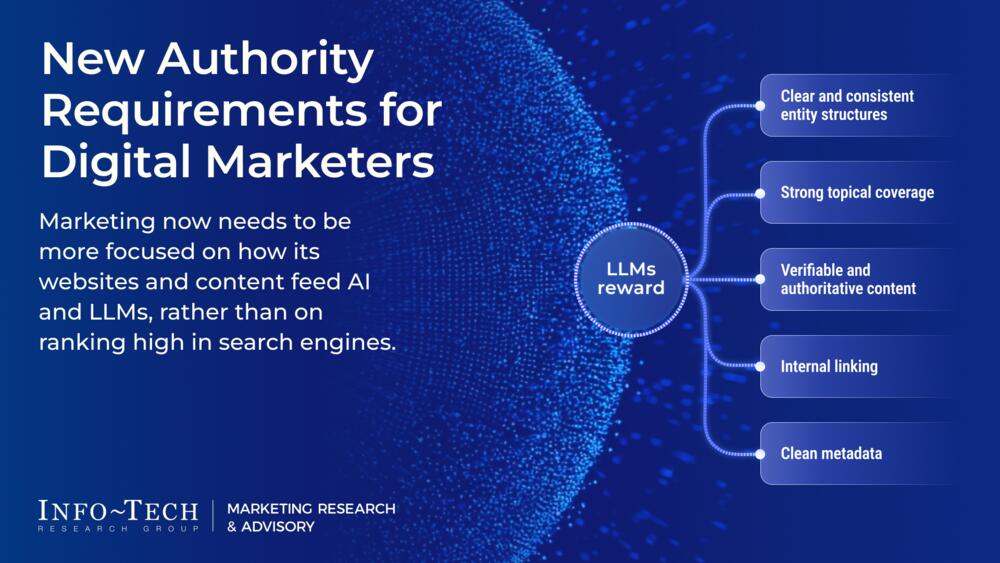
New Authority Requirements for Digital Marketers
Marketing now needs to be more focused on how its websites and content feed AI and LLMs, rather than on ranking high in search engines.
LLMs reward:
- Clear and consistent entity structures
- Strong topical coverage
- Verifiable and authoritative content
- Clean metadata
- Internal linking
Research shows that LLM outputs frequently cite pages that do not rank highest organically but demonstrate stronger structure or clarity.
Adobe’s acquisition of Semrush – a landmark approximately $1.9 billion deal – is one of the most notable recent acquisitions and signals consolidation at scale in the SEO and broader martech landscape. This will bring a leading SEO and brand-visibility platform into the portfolio of a major enterprise software provider, which is uncommon in the SEO tools sector and suggests a shift toward an integrated ecosystem.
Shift Toward Integrated Ecosystems Accelerates (Adobe × Semrush)
Semrush gives Adobe something it has never had at scale: a direct link between content production and measurable search performance, particularly for AI and competitive intelligence. This recognizes the fundamental shift in how people (customers and competitors) find and interact with content on the web.
Adobe brings: Content creation (Firefly, Creative Cloud); and digital experience analytics, measurement, and personalization (Experience Cloud).
Semrush contributes: SEO research, content optimization, competitive intelligence, and clickstream modeling. They will remain as an independent company.
This helps Adobe strategically by bringing advanced search and AI-driven visibility tools into its enterprise stack. The deal positions Adobe to address the evolving ways customers discover brands – especially as generative AI reshapes search.
Semrush’s Differentiation Is Strengthened Under Adobe
Semrush, which is expected to continue operating independently following the acquisition, differentiates itself through:
- Broad, integrated workflows across SEO; generative engine optimization (GEO); and content, local, social, and competitive intelligence.
- A differentiated positioning in search visibility and audience reach supported by data-driven SEO and GEO capabilities.
- Transparent, list-priced tiering across Pro, Guru, Business, and Enterprise plans.
- Established enterprise workflows supporting governance, scalability, and third-party integrations.
- Data research powered by Datos (a Semrush company), leveraging large-scale clickstream data for competitive and market-level modeling.
While Adobe integration may yield potential benefits, realization will depend on execution priorities, customer adoption, and alignment with Adobe’s broader platform roadmap.
| Semrush | What You're Really Buying |
| Semrush (suite & tiers) | End-to-end workflows in one platform: keyword research, site audit, enterprise-grade crawling, rank tracking, content toolkit, local, social, and trends market intelligence.
|
Conclusion
AI search compresses visibility into fewer, higher-bar answers. As rankings and click volume decline in importance, winning brands will be those that pair authoritative content and clear entity structures with strong operational discipline – automated internal linking, consistent signals across SEO, PR, local, and social, and data-driven topic selection aligned to how AI systems evaluate trust and relevance.
Semrush’s broad, integrated stack – spanning research, content optimization, competitive intelligence, and governance – combined with Adobe’s partner ecosystem and experience platform, offers marketing teams a structured path to maintain and improve visibility as search continues to evolve. The advantage will favor organizations that execute with clarity, coherence, and speed in an AI-mediated discovery environment.
Info-Tech’s Related Publications and Deliverables:
- Elevate Your SEO Strategy
- Create an Effective SEO Keyword Strategy: This document outlines leading SEO methods that focus on relevant, keyword-rich content to move buyers through their journey and build long-term relationships.
- Search Engine Optimization Software Selection Guide: Unlock the future of search and SEO. Learn why search and SEO software is critical to your business. What are the capabilities, vendors, and customer reviews saying about these companies? Then, define your requirements and use cases to discover an SEO vendor that fits your needs.
- For the latest scores for 17 SEO vendors, with downloadable category and product reports, please see SoftwareReviews’ SEO software category. Each vendor brings unique capabilities to the SEO and digital marketing landscape, offering specialized tools and services to enhance customer engagement.
- Visit infotech.com/software-reviews for the most current data and reports.
Other Sources and Related Publications:
- Adobe’s own announcement: “Adobe to Acquire Semrush” — outlines deal terms, strategy, and reasoning.
- TechCrunch summary: “Adobe to Buy Semrush for $1.9 billion” — confirms price per share, deal value, and what Adobe aims to add to its marketing stack.
- Search Engine Journal: “Adobe To Acquire Semrush In $1.9 Billion Cash Deal” — explains how Semrush tools will be folded into Adobe’s Experience Cloud and benefit marketers.
- Coverage by The Verge: “Adobe to Acquire Digital Marketing Platform Semrush for $1.9 billion” — gives an overview of how this fits into Adobe’s expanding AI-powered marketing offerings.
- Additional analysis: “Adobe Acquires Semrush for $1.9B in Major Push Into AI-Powered Marketing Tools” — context on why this move is essential given rising AI-driven traffic and brand-visibility needs.
- Background on Semrush (what the company does, its products, and recent AI focus): overview from its Wikipedia entry.