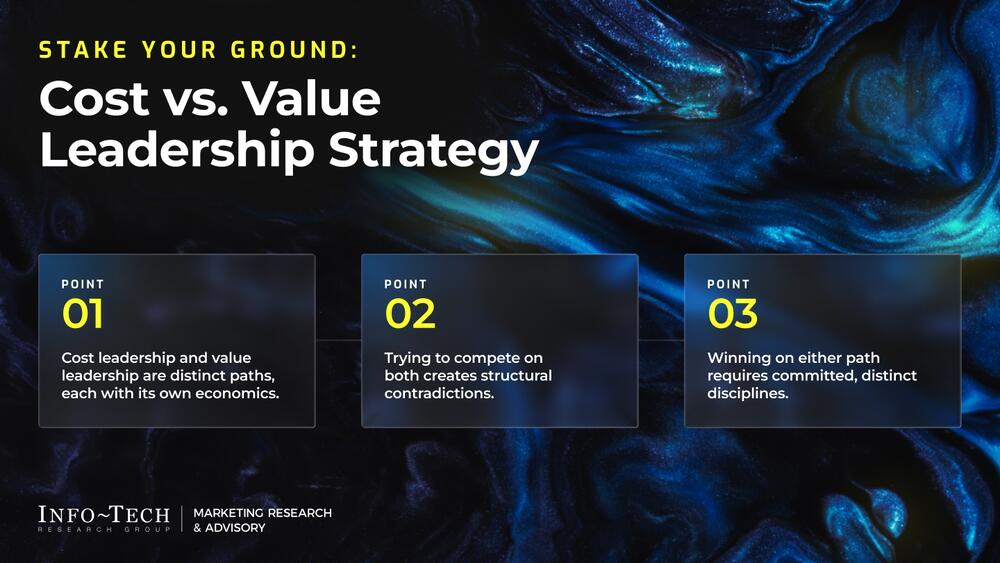
Stake Your Ground: Cost vs. Value Leadership Strategy
Most brands aren't underperforming because of effort — they're underperforming because they refuse to focus. Too many business and marketing leaders struggle to commit to a cost or value leadership position and instead try to play both sides of the coin. This creates structural contradictions of being “stuck in the middle,” creating misaligned resources, messaging, and execution, trying to juggle an inconsistent brand.
The brands that succeed make a meaningful choice to emphasize cost or value leadership, commit resources to that approach, and stop trying to be everything to everyone. Strategic clarity is what separates market leaders from the stuck-in-the-middle majority.
Included Research:
| Name | Actions |
|---|---|
|
Stake Your Ground: Cost vs. Value Leadership Strategy
|
Introduction
Most brands aren't failing because their products are not strong or their teams aren't working hard enough. They’re failing because they're unfocused. When strategy and brand positioning aren't aligned, execution breaks down: decisions slow, investment dilutes, messaging confuses the market, and growth stalls. The root cause is rarely effort — it’s a lack of strategic focus. The most common shortfall is the failure to explicitly define a strategic position as either a cost leader or a value leader, and to align resources and teams around that chosen focus. According to Phoenix Strategy Group, firms with focused positioning now account for 55% of the market. As A.G. Lafley and Roger L. Martin put it in Playing to Win, “The more your choices look like those of your competitors, the less likely you will ever win.”
The argument unfolds in three points: the distinct economics of each path, why hybrids fail, and what discipline each path requires.
Point #1: Cost leadership and value leadership are distinct paths, each with its own economics.
Cost leadership and value leadership demand different capabilities, resources, and cultural mindsets, and the economics of each are fundamentally different.
Cost leadership prioritizes efficiency and affordability to capture price-sensitive segments. The levers are well-known: COGS reduction through aggressive supplier negotiation and volume commitments; SG&A efficiency targeted below industry average; and automation and AI to standardize onboarding for lower-ACV customer segments. The model wins on operational scale, not pricing power.
Value leadership, by contrast, targets premium features and service for markets willing to pay more. The economics are striking: brand premiums of 20-100%+ over commodity alternatives without losing significant share; customer lifetime value 3-5x higher than cost leaders due to emotional switching costs; and acquisition costs roughly 50% lower for repeat customers driven by brand affinity. Differentiation creates loyalty that insulates you from price wars while cost leaders must constantly spend to attract price-switchers.
Cost-leader exemplars: Walmart, Southwest Airlines, IKEA – companies that built systems delivering acceptable value at the lowest sustainable cost. Value-leader exemplars: Apple, Adobe, Salesforce – companies whose customers consistently believe they’re worth more. Neither path is inherently better, and both can drive lasting success when executed with discipline.
Point #2: Trying to compete on both creates structural contradictions.
Trying to win on cost and value simultaneously looks like flexibility in theory, but in execution, it produces friction, diluted investment, and inconsistent messaging.
The reason it fails is structural. Cost leadership demands efficiency and standardization. Value leadership demands investment, innovation, and experience. These operating models pull organizations in opposite directions. Every dollar spent on differentiation is a dollar not spent on cost reduction, and every standardization decision is a constraint on the premium experience. The pattern is familiar: pricing pressure without a true cost advantage, differentiation claims unsupported by investment, and messaging that confuses the market about who the brand is actually for.
Sears tried to balance retail and online without committing to either and lost both battles. BlackBerry tried to defend its enterprise cost efficiency while pursuing consumer innovation and lost its edge in both. In both cases, indecision – not ambition – was the killer.
Point #3: Winning on either path requires committed, distinct disciplines.
Once you've made the choice, the playbook is specific to your path – and the disciplines required to win as a cost leader are not the disciplines that win as a value leader.
Cost leadership isn't about being cheap; it’s about building a system that delivers acceptable value at the lowest sustainable cost. Six disciplines are non-negotiable when committing to a cost leadership model.
- Operational efficiency: Simplify, standardize, reduce rework.
- Cost-structure control: Minimize waste.
- Cost accountability: Clear ownership at every scale.
- Supply chain optimization: Consolidate suppliers, build strong partnerships.
- Predictability: Straightforward, market-driven products.
- Market focus: On price-sensitive customers who reward affordability and reliability.
Value leadership only works if your customers consistently believe you're worth more. That requires commitment across an entirely different set of criteria:
- Defensible uniqueness: Features competitors can't copy.
- Innovation: R&D that leads rather than follows.
- Quality excellence: Design, usability, service.
- Brand storytelling: A narrative blending emotional and functional value.
- Customer intimacy: Feedback that shapes the roadmap.
- Culture of creativity: That protects long-term thinking.
The six-pillar structure mirrors how exemplar companies organize internally: cost leaders concentrate executive attention on supply chain, ops, and unit economics; value leaders concentrate it on R&D, brand, and customer experience. Mixing the two dilutes both.
Recommendations
- Run an honest self-diagnostic: rate your organization on cost vs. value across strategic style, decision-making, and culture. The rating usually reveals where you actually sit, not where you’d like to sit. Too many organizations want to default to the value play when, in fact, their products, services, and support organizations are not up to the standard demanded in that segment. That’s not a criticism, but rather it reflects the reality of your situation.
- Benchmark against competitors at your scale and audience, not industry giants. Find where you can plausibly win.
- If you sit on a cost path, invest in efficiency, supply chain, and standardization. If you sit on a value path, invest in differentiation, R&D, brand, and customer intimacy. Sequence the few moves that decide the chosen ground.
- If you're “in between,” make the trade-off visible by naming what you’ll stop doing. Narrow the battlefield to markets where one strategy can win decisively, then align execution behind that choice.
- Communicate the choice internally before the market hears it. Sales, product, and marketing all need to be messaged from the same position.
Conclusion
The companies that dominate their markets – whether on cost or on value – share one trait: they made the choice, aligned the organization behind it, and stopped trying to be everything to everyone. The hardest part isn't the strategy: It is the discipline to commit.
In our research, the single strongest predictor of brand momentum at mid-market scale is not budget, headcount, or category; it's clarity of position. The brands that grow fastest are the ones whose customers can articulate, in one sentence, what they're for and who they're for. If your team struggles to perform this basic task, it’s time to pick a lane and commit to who you are trying to be, and for whom.
Other Related Publication and Deliverables
- Position Your Brand Strategically as a Cost or Value Leader (related Info-Tech publication)
- Priced to Win: Build an Optimized Pricing Strategy (related blueprint)